
Table of Contents
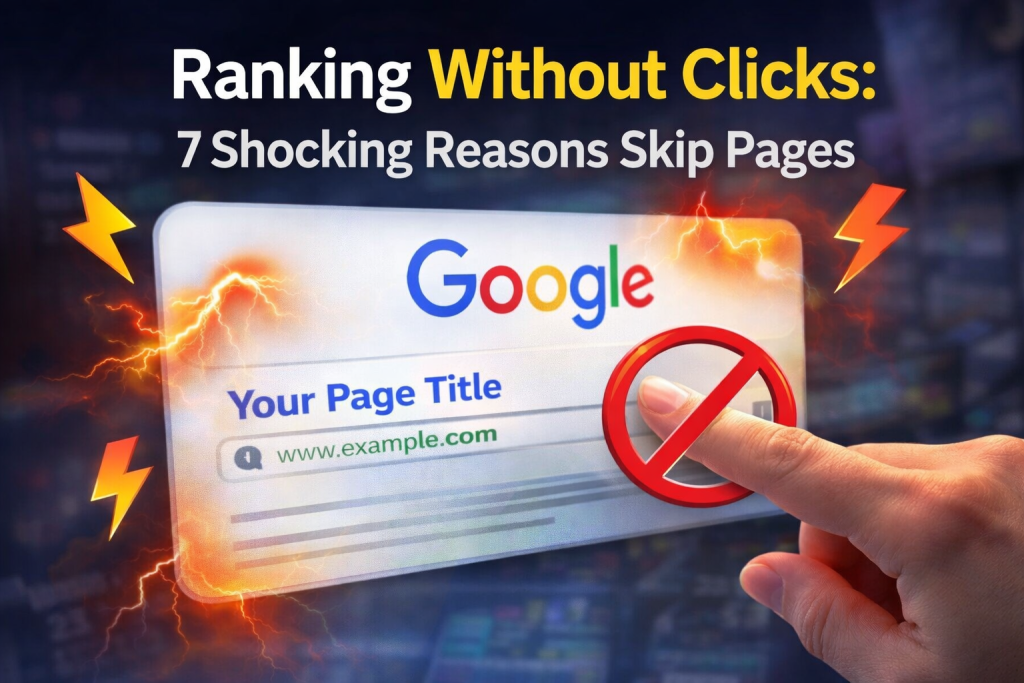
Ranking Without Clicks is one of the most confusing SEO situations today.
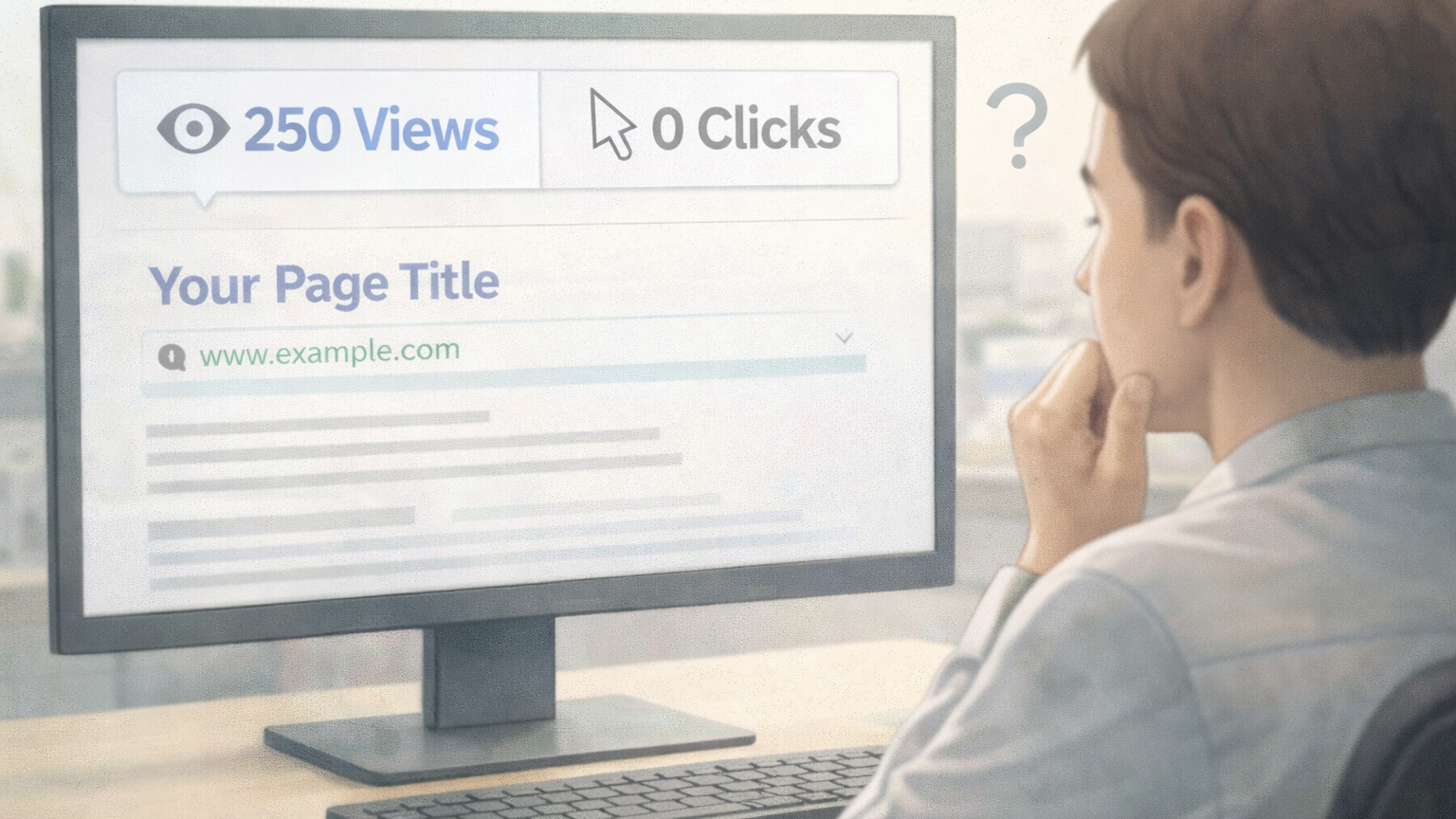
Pages get indexed. Visibility appears in Search Console. Sometimes impressions even grow.
Yet clicks stay flat — or disappear entirely.
This problem is not caused by penalties, broken SEO, or poor content alone.
It happens because Google is no longer ranking pages only to be clicked.
It is ranking pages to serve outcomes.
Understanding this shift changes how you see SEO completely.
Understanding Visibility Without Traffic Beyond Traditional SEO
Ranking Without Clicks does not mean your page is useless.
It means your page is informationally acknowledged but behaviorally ignored.
Google may trust your information but still decide:
- Users do not need to visit your page
- The answer can be resolved elsewhere
- The intent does not require exploration
This creates a new SEO reality where presence ≠ traffic.

Why Ranking Without Clicks Is Increasing Rapidly?
Search engines are evolving faster than content strategies.
Today, Google optimizes for:
- Reduced friction
- Faster resolution
- Lower cognitive effort
If a query can be resolved without engagement, clicks become optional.
This is why Ranking Without Clicks is becoming normal, not rare.
1. Ranking Without Clicks Caused by Instant Resolution
When answers eliminate curiosity
Many queries no longer create curiosity loops.
If a user searches something that can be:
- Summarized
- Defined
- Compared quickly
Google resolves it immediately.
Your page may rank, but the intent is already satisfied.
This form of Ranking Without Clicks happens when:
- The user does not need context
- The decision does not require depth
- The outcome is binary
2. Ranking Without Clicks Due to Intent Compression
When multiple questions collapse into one
Search intent is no longer layered.
AI-driven systems compress:
- “What is this?”
- “Is it good?”
- “Should I use it?”
Into a single response.
Pages ranking below that response lose relevance instantly.
Ranking Without Clicks emerges because the search journey ends too early.
3. Ranking Without Clicks Triggered by SERP Trust Bias
When Google becomes the authority
Users trust Google’s interface more than external sites.
If Google presents:
- Tables
- Summaries
- AI explanations
Users hesitate to click out.
Your content may be accurate, but the trust is already consumed inside the SERP.
This is one of the most overlooked causes of Ranking Without Clicks.
4. Ranking Without Clicks from Perceived Effort Cost

When clicking feels like work
Users subconsciously evaluate effort.
If clicking means:
- Reading long content
- Interpreting complex ideas
- Scanning multiple sections
They avoid it.
Even strong pages suffer Ranking Without Clicks when:
- Headlines feel heavy
- Structure feels dense
- Purpose is unclear
Effort avoidance is now a ranking filter.
5. Ranking Without Clicks Caused by Query Maturity
When users already know the basics
As topics mature, audiences evolve.
Early-stage queries need explanations.
Late-stage queries need confirmation or direction.
If your page still explains basics, advanced users skip it — even if it ranks.
This mismatch creates Ranking Without Clicks without any technical issue.
6. Ranking Without Clicks Because of Decision Deflection
When Google delays action intentionally
Some queries signal uncertainty.
Instead of pushing users to external pages, Google:
- Shows neutral information
- Avoids strong recommendations
- Keeps users exploring
Your page ranks, but the system deflects clicks intentionally.
This strategic deflection results in Ranking Without Clicks that feels unexplained.
7. Ranking Without Clicks Due to Emotional Neutralization
When content fails to trigger urgency or relevance
Clicks are emotional decisions.
If content:
- Feels generic
- Lacks urgency
- Does not reduce doubt
Users don’t act.
Google measures this passivity and gradually deprioritizes engagement.
Ranking Without Clicks often starts emotionally, not algorithmically.
The Silent Role of User Satisfaction Signals
Search engines closely observe what users do after seeing a result.
Not clicks alone — but:
- how long users stay
- whether they return to results
- if they refine the same query again
When users hesitate, pause, or bounce repeatedly, it sends a signal that something is unresolved.
Even visible pages lose momentum when satisfaction remains incomplete.
This behavioral layer explains why some pages appear stable yet fail to attract meaningful interaction.
Why Familiarity Reduces Click Motivation?
As topics become widely discussed, familiarity increases.
Users feel they already “know enough.”
When search results look repetitive:
- similar headlines
- predictable explanations
- identical structures
curiosity drops.
In such cases, users scan but don’t act.
This lack of novelty silently affects engagement over time.
The Impact of Over-Clarity on Engagement
Ironically, being too clear can reduce clicks.
When users see:
- complete summaries
- direct answers
- simplified breakdowns
they feel no need to explore further.
This creates a paradox where helpful presentation reduces external interaction.
Pages are acknowledged, but not visited.
How Decision Fatigue Influences Search Behavior?
Modern users face decision overload.
Too many options, comparisons, and opinions create fatigue.
In response, users:
- delay action
- rely on surface-level cues
- avoid deep exploration
Search engines adapt by limiting unnecessary navigation.
This psychological factor is rarely discussed in SEO, yet it directly affects engagement patterns.
Why Neutral Content Gets Ignored Faster?
Neutral tone feels safe — but forgettable.
When content avoids:
- perspective
- stance
- prioritization
users struggle to extract direction.
They don’t disagree — they disengage.
Search engines interpret this passivity as low utility, even if the information is accurate.
The Difference Between Visibility and Selection
Visibility means being shown.
Selection means being chosen.
Search engines increasingly optimize for selection signals:
- confidence
- relevance timing
- clarity of outcome
Pages that lack these traits remain visible but underutilized.
Understanding this distinction changes how content should be written.
How Small Friction Points Block Engagement?
Minor issues compound:
- vague introductions
- delayed answers
- unclear purpose
Users decide within seconds whether to proceed.
If friction appears early, engagement ends early.
These micro-frictions rarely appear in audits, yet they shape performance.
Why Ranking Stability Can Be Misleading?
Stable positions create false confidence.
Many site owners assume:
- ranking = success
- visibility = value
But stable rankings with declining engagement indicate deeper alignment issues.
Ignoring this stage makes recovery harder later.
How Content Should Be Evaluated Today?
Instead of asking:
“Is this optimized?”
Ask:
- Does this reduce doubt?
- Does this guide action?
- Does this feel timely?
Modern search favors usefulness over completeness.
Long-Term Effects of Ignoring Engagement Patterns
When engagement weakens consistently:
- authority perception declines
- trust signals weaken
- recovery becomes slower
Early adjustments preserve relevance.
Late reactions cost visibility.
Why Behavioral SEO Will Matter More Than Technical SEO?
Technical foundations remain important.
But behavior determines survival.
As systems become better at interpreting human responses, content must align with:
- intent timing
- emotional readiness
- decision context
This shift defines the next phase of SEO.
How to Detect Ranking Without Clicks Early?
Signals most people ignore
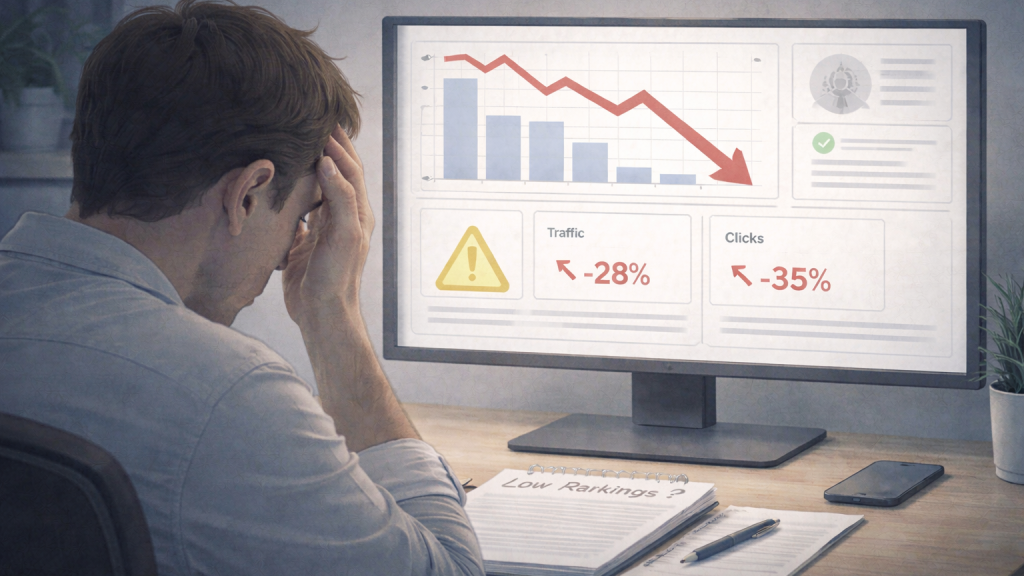
- Impressions rise but CTR stays flat
- Average position stable, traffic declining
- Queries show visibility but no session depth
These are behavioral signals, not SEO errors.
Fixing Ranking Without Clicks Without Rewriting Everything
Strategic realignment, not replacement
You don’t always need new content.
You need:
- Clear decision framing
- Reduced effort paths
- Stronger relevance signals
Fixes include:
- Sharper introductions
- Direct outcomes
- Clear “why this matters now”
This often restores clicks faster than publishing new pages.
Why Ranking Without Clicks Will Grow in the AI Era?
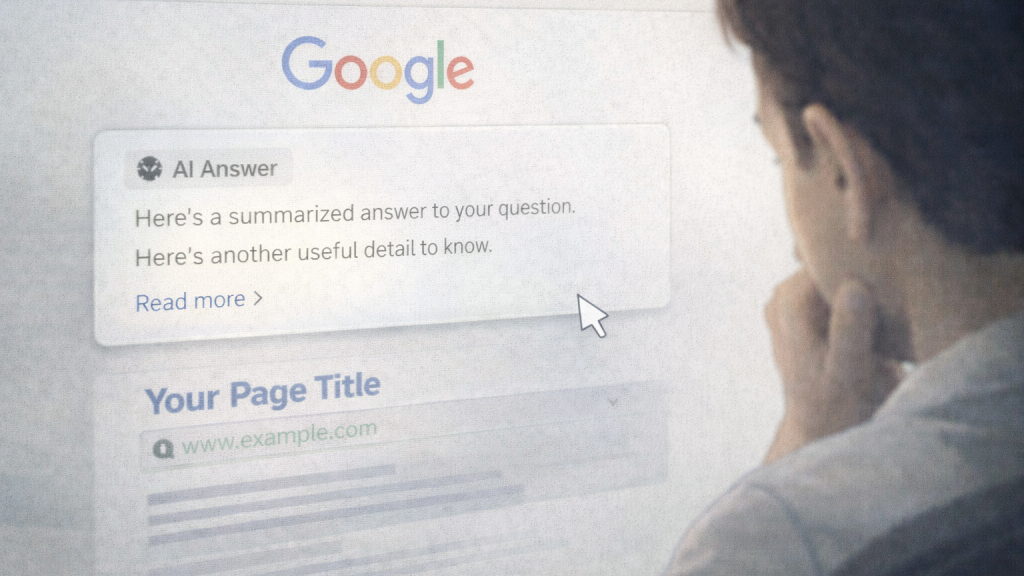
AI systems optimize for completion, not exploration.
As AI improves:
- Simple clicks disappear
- Only high-value curiosity survives
- Shallow intent stops converting
Google itself explains how modern search systems interpret queries and intent.
Ranking Without Clicks vs Low Rankings (Key Difference)
Low ranking means invisibility.
Ranking Without Clicks means ignored visibility.
The fix is not SEO expansion — it is intent refinement.
Building Content That Escapes Ranking Without Clicks
What actually works now
- Decision-oriented writing
- Perspective, not repetition
- Clear value exchange
Pages that help users decide faster earn clicks.
Others remain visible but unused.
Why Ranking Without Clicks Is a Warning, Not a Failure?
This phenomenon signals:
- Intent evolution
- Behavior change
- Opportunity for authority
Most sites ignore it.
Smart sites adapt early.
Final Insight: Clicks Follow Clarity, Not Rankings
Optimization gets you seen.
Clarity gets you chosen.
This is why some pages dominate while others quietly exist.
For deeper SEO behavior concepts aligned with real user decision patterns, you can explore this detailed blogging integration guide.
Conclusion
Ranking Without Clicks is not a bug in SEO.
It is a reflection of how search is changing.
Those who understand it stop chasing rankings —
and start earning attention.