
Table of Contents
Google Ads vs Meta Ads is one of the most common comparisons in digital marketing today. Businesses often struggle to decide which advertising platform is better for getting leads, sales, and website traffic. Both platforms are powerful and widely used, but they work in very different ways.
If you are a beginner in digital marketing, understanding Google Ads vs Meta Ads will help you choose the right platform for your marketing strategy. Some businesses get amazing results with Google Ads, while others grow faster with Meta Ads on Facebook and Instagram.
In this guide, we will explore Google Ads vs Meta Ads, their features, advantages, and the 7 powerful differences between them. By the end of this article, you will clearly understand which platform is best for your business in 2026.
What is Google Ads?
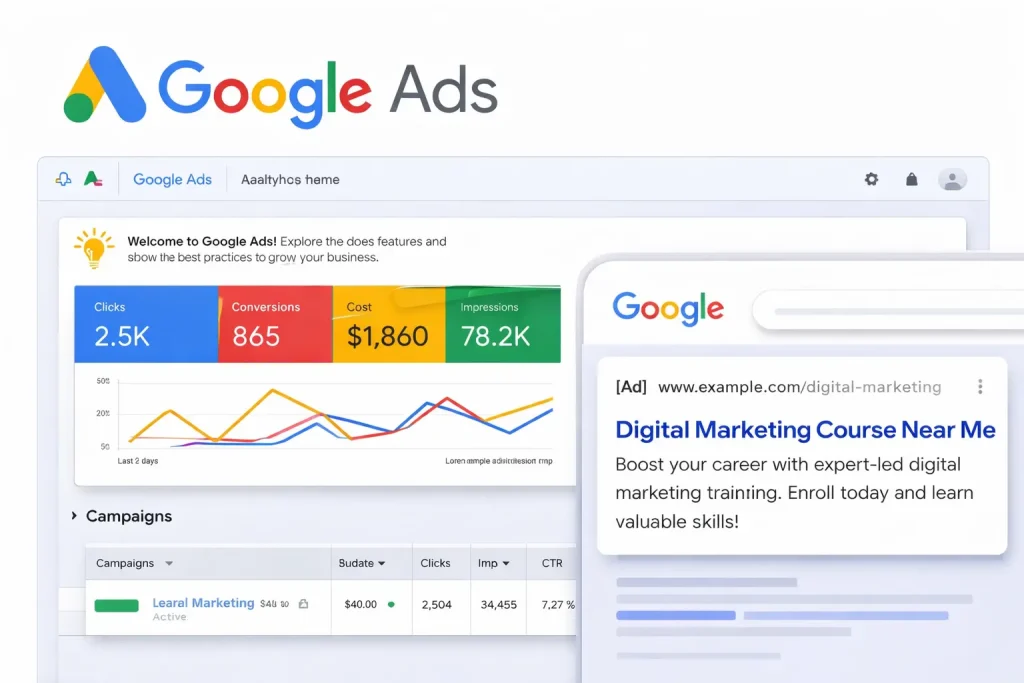
Before understanding Google Ads vs Meta Ads, it is important to know how each platform works.
Google Ads is an online advertising platform created by Google that allows businesses to promote their products and services through search, display, and video advertising. You can learn more about how this platform works on the Google Ads official website.
When people search for something on Google, businesses can show ads based on keywords. For example, if someone searches:
“digital marketing course near me”
Google may show advertisements at the top of the search results.
This type of advertising is called intent-based marketing because users are already searching for a solution.
Key Features of Google Ads
Some important features of Google Ads include:
- Search ads on Google results
- Display ads on websites
- YouTube video ads
- Keyword targeting
- High purchase intent traffic
Because people search with a purpose, Google Ads often brings high-quality leads and conversions.
What is Meta Ads?
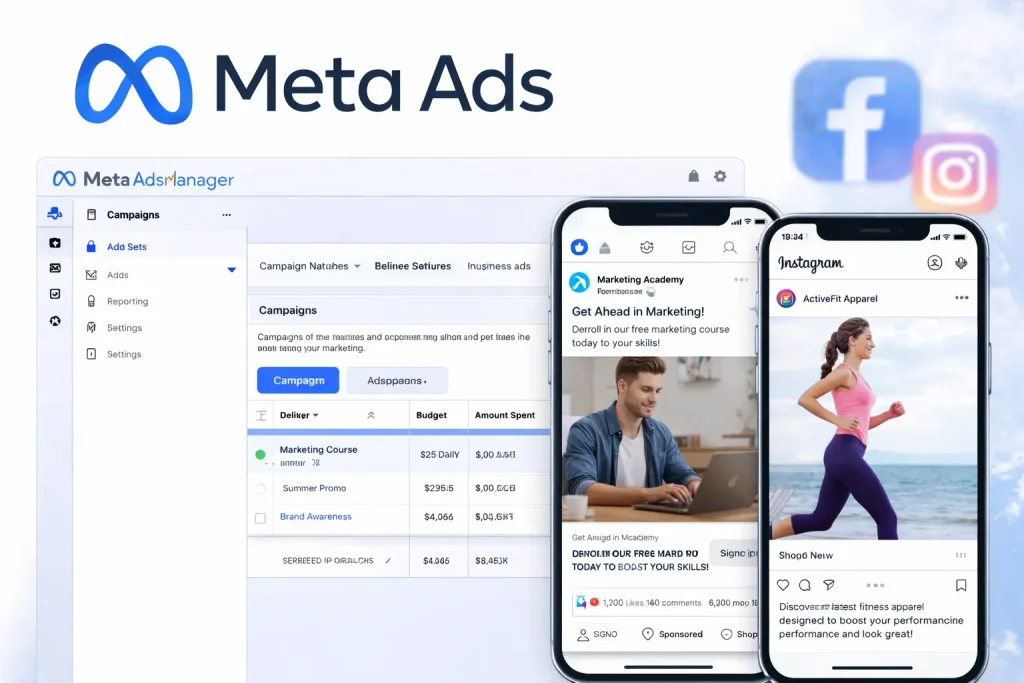
To understand Google Ads vs Meta Ads, we also need to understand Meta Ads.
Meta Ads is the advertising platform used on Facebook and Instagram. Businesses can promote products or services through sponsored posts, videos, reels, and stories.
Unlike Google Ads, Meta Ads works on interest-based targeting. Instead of waiting for users to search, Meta shows ads to people based on their:
- Interests
- Age
- Location
- Online behavior
- Demographics
For example, if someone frequently interacts with fitness content, Meta may show them ads for gym memberships or fitness products.
Meta Ads is mainly used for:
- Brand awareness
- Product discovery
- Social media engagement
Google Ads vs Meta Ads: How Advertising Works
The biggest difference in Google Ads vs Meta Ads is how the ads reach users.
Google Ads shows advertisements when users actively search for something.
Meta Ads shows advertisements while users scroll social media.
This means the customer journey is different on each platform.
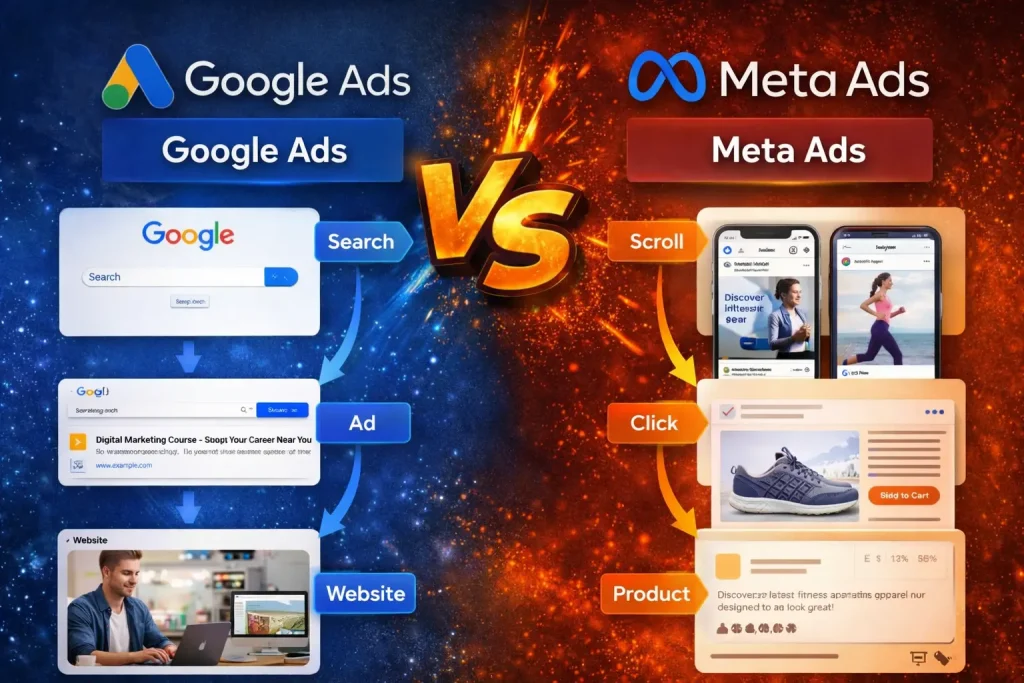
Google Ads approach
User searches → sees ad → clicks → buys product
Meta Ads approach
User scrolls → sees ad → becomes interested → clicks → learns about product
Because of this difference, both platforms serve different marketing goals.
Google Ads vs Meta Ads: 7 Powerful Differences
Now let’s explore the 7 powerful differences between Google Ads vs Meta Ads that every marketer should know.
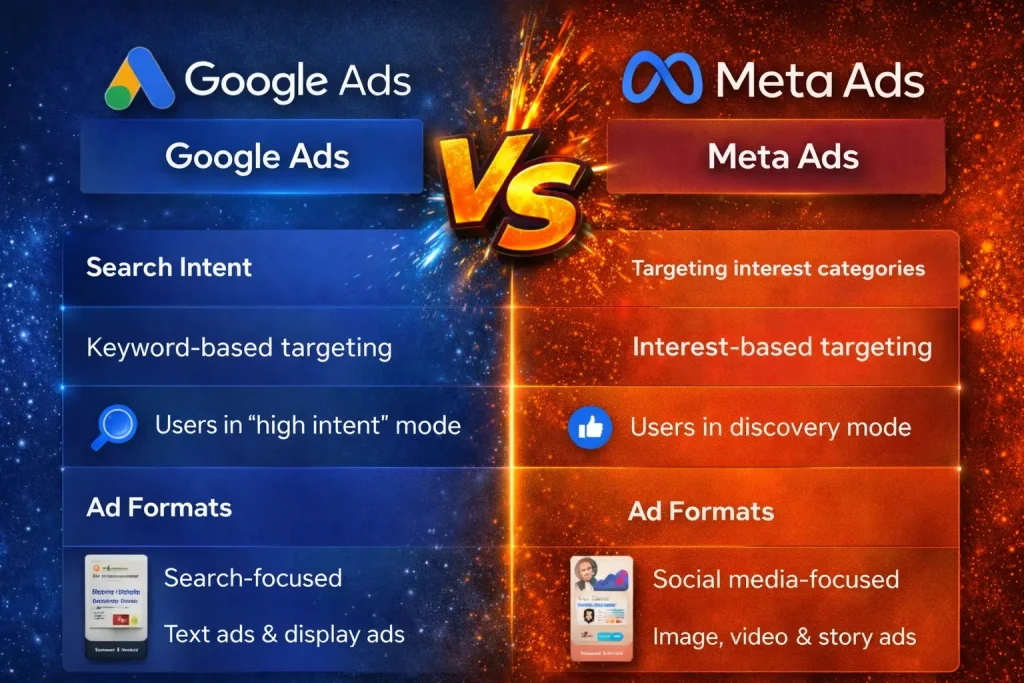
1. Search Intent vs Discovery Marketing
The first difference in Google Ads vs Meta Ads is user intent.
Google Ads works with search intent. Users already want something and search for it.
Example:
“buy running shoes online”
Meta Ads works with discovery marketing. Users may not be looking for a product, but they discover it through an advertisement.
Example:
A user scrolling Instagram sees an ad for stylish running shoes.
2. Targeting Method
Another major difference in Google Ads vs Meta Ads is targeting.
Google Ads uses:
- Keywords
- Search queries
- Location targeting
Meta Ads uses:
- Interests
- Age groups
- Behavior patterns
- Social media activity
This makes Meta Ads extremely powerful for audience targeting.
3. Ad Placement
Ad placement is another important factor in Google Ads vs Meta Ads.
Google Ads placements include:
- Google search results
- YouTube videos
- Websites in the Display Network
Meta Ads placements include:
- Facebook feed
- Instagram feed
- Stories and reels
- Messenger ads
Both platforms offer multiple placements, but the environment is different.
4. Cost of Advertising
When comparing Google Ads vs Meta Ads, cost also matters.
Google Ads often has higher cost per click (CPC) because competition for keywords is high.
Meta Ads usually has lower CPC, especially for awareness campaigns.
However, the return on investment depends on the business type and marketing goal.
5. Conversion Intent
Another powerful difference in Google Ads vs Meta Ads is conversion intent.
Google Ads users already want a product or service. This means they are closer to making a purchase.
Meta Ads users may still be discovering the product. They might click the ad but take more time to buy.
Because of this, Google Ads often generates faster conversions, while Meta Ads builds long-term brand awareness.
6. Best Use Cases
The next difference in Google Ads vs Meta Ads is when to use them.
Google Ads works best for:
- Local services
- Emergency services
- High intent products
- Lead generation
Meta Ads works best for:
- E-commerce products
- Fashion brands
- Lifestyle businesses
- Brand awareness campaigns
Understanding this difference helps marketers choose the right platform.
7. Marketing Strategy
The final difference in Google Ads vs Meta Ads is strategy.
Google Ads is perfect for capturing demand.
Meta Ads is excellent for creating demand.
This is why many digital marketers recommend using both platforms together.
For example:
Meta Ads can create interest in your brand.
Google Ads can capture users when they search for your product later.
Google Ads vs Meta Ads: Which One is Better?
The question many businesses ask is: Google Ads vs Meta Ads — which is better?
The truth is that both platforms are powerful, but the best choice depends on your marketing goals.
Choose Google Ads if you want:
- High intent traffic
- Fast conversions
- Search based leads
Choose Meta Ads if you want:
- Brand awareness
- Social media engagement
- Interest based targeting
Most successful businesses combine Google Ads vs Meta Ads to create a complete digital marketing strategy.
When Should Businesses Use Google Ads vs Meta Ads Together?
Many marketing experts recommend using Google Ads vs Meta Ads together instead of choosing only one platform.
For example:
Step 1: Use Meta Ads to introduce your brand.
Step 2: People become interested and search on Google.
Step 3: Your Google Ads capture those searches and convert them into customers.
This strategy increases both brand visibility and conversions.
Future of Google Ads vs Meta Ads in 2026
The digital marketing industry is constantly evolving. In 2026, both platforms are becoming more powerful with AI targeting and automation tools.
Google Ads is improving with:
- AI bidding strategies
- Smart campaigns
- Better search targeting
Meta Ads is improving with:
- AI audience targeting
- advanced ad creatives
- improved data analytics
Because of these improvements, the competition between Google Ads vs Meta Ads will continue to grow.
Key Benefits of Online Advertising for Businesses
Online advertising has become an essential part of modern marketing. It helps businesses reach their target audience faster and more efficiently than traditional marketing methods.
Some important benefits include:
- Wider Audience Reach – Businesses can reach customers across different cities and even countries.
- Precise Targeting – Ads can be shown to people based on their interests, age, location, and behavior.
- Budget Control – Businesses can start advertising with a small budget and increase spending as results improve.
- Real-Time Results – Marketers can track clicks, impressions, and conversions instantly.
- Better Return on Investment – Properly optimized campaigns often generate strong ROI.
Tips for Running Successful Digital Advertising Campaigns
Running successful advertising campaigns requires planning, testing, and continuous optimization. Marketers who follow a structured approach usually achieve better results.
To improve advertising performance, marketers should also use different analytics and marketing tools. You can explore some helpful tools in this guide on free digital marketing tools for beginners.
Some helpful tips include:
- Define clear campaign goals before launching ads.
- Use strong ad creatives that capture attention quickly.
- Write clear and simple ad copy that explains the offer.
- Test different audience groups to find the most responsive users.
- Monitor campaign performance regularly and make improvements when needed.
- Optimize landing pages to increase conversions.
Conclusion
In the debate of Google Ads vs Meta Ads, there is no single winner. Both advertising platforms have unique strengths and marketing advantages.
Google Ads is ideal for capturing people who are already searching for a solution, while Meta Ads is excellent for reaching new audiences through social media.
Businesses that understand the differences between Google Ads vs Meta Ads can create smarter marketing strategies and achieve better advertising results.
If you want long-term success in digital marketing, the best approach is to combine both platforms and use them strategically to grow your business.