
Table of Contents
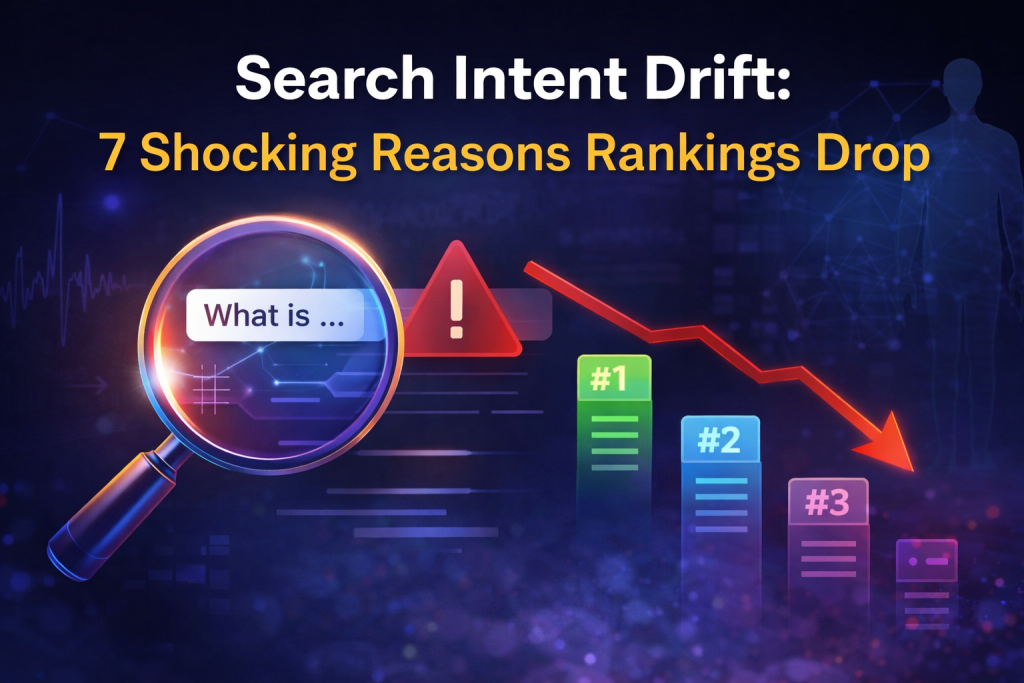
Search intent drift is not an SEO myth or a temporary fluctuation.
It is a structural change in how users think, search, and decide — and it is one of the biggest reasons why rankings collapse without warnings, penalties, or technical errors.
Most websites lose traffic not because they did something wrong, but because they stayed static while intent moved forward.
This article explains the real, rarely discussed reasons behind this shift, and why even “perfectly optimized” pages silently fail.

Understanding Search Intent Drift at a Deeper Level
Search intent drift occurs when the expectation behind a query evolves, but the content addressing that query does not.
This evolution is subtle:
- Keywords remain the same
- Search volume remains stable
- Competition looks familiar
Yet the user’s mental question has changed.
Google’s job is not to reward accuracy — it is to satisfy intent faster and better. When intent shifts, Google replaces results.
Why Traditional SEO Fails to Detect this ranking pattren
Most SEO audits focus on:
- Keywords
- Backlinks
- On-page factors
- Technical health
None of these reveal intent misalignment.
Search intent drift is invisible because:
- Rankings drop gradually
- No manual action appears
- Pages still index properly
- Tools show “no major issue”
By the time traffic loss is noticed, intent has already moved on.
1. Search Intent Drift Caused by Audience Evolution

When users outgrow your content
Audiences mature.
A keyword that once attracted beginners eventually attracts:
- Professionals
- Decision-makers
- Buyers with experience
Your content may still be correct, but no longer sufficient.
This type of shift happens when:
- Users want frameworks instead of definitions
- Examples instead of theory
- Opinions instead of neutrality
Google tracks engagement signals and upgrades results accordingly.
2. Search Intent Drift Through SERP Feature Dominance

When Google answers half the question itself
Featured snippets, AI summaries, and PAA boxes now absorb basic intent.
As a result:
- Users no longer click for simple answers
- Remaining clicks demand depth or perspective
If your page only satisfies surface intent, Google deprioritizes it.
This creates search intent drift where:
- “What is” content loses visibility
- Strategic, analytical content replaces it
3. Search Intent Drift Triggered by Time Sensitivity

Same keyword, different urgency
User intent changes based on context:
- Economic shifts
- Industry updates
- Technology changes
A keyword searched casually in the past may now be searched urgently.
If your content tone doesn’t reflect urgency, risk, or relevance, users bounce — and Google notices.
This time-based search intent drift is often misdiagnosed as “algorithm volatility.”
4. Semantic Expansion and Search Intent Drift

When keywords silently broaden
Google continuously expands the semantic scope of queries.
A keyword that once meant one core idea may now include:
- Tools
- Case studies
- Comparisons
- Contrarian views
If your content addresses only the original interpretation, it becomes incomplete.
This semantic expansion is a major driver of search intent drift, yet keyword tools rarely expose it.
5. Search Intent Drift Caused by Content Saturation
When similarity becomes a weakness
As more websites publish similar content:
- Google stops rewarding repetition
- It seeks differentiation
This leads to a novelty-based intent shift.
Pages that:
- Introduce new terminology
- Offer original frameworks
- Present uncommon insights
gain preference.
This is why highly optimized but generic content suddenly disappears.
6. Authority Reassessment and Search Intent Drift
When Google changes who should rank
Authority is contextual, not permanent.
Earlier, general blogs ranked for many topics.
Now, Google increasingly favors:
- Specialists
- First-hand experience
- Demonstrated depth
If your domain no longer matches Google’s ideal authority profile, rankings drop even if content quality remains unchanged.
This creates domain-level search intent drift.
7. Emotional Search Intent Drift (The Most Ignored Factor)
Intent is emotional before informational
Users don’t just search for answers — they search for reassurance, confidence, or validation.
Over time:
- Curiosity turns into anxiety
- Exploration turns into decision-making
- Neutrality turns into urgency
If your content does not emotionally align with users, engagement falls.
Google interprets this as poor intent match.
How to Identify Search Intent Drift Early
Signals most SEOs overlook
- Top-ranking pages change tone
- Headlines become more decisive
- Content becomes more opinionated
- Structure shifts from paragraphs to frameworks
These changes signal intent evolution, not SEO tricks.
Fixing Search Intent Drift Without Killing Existing Content
Intent realignment strategy
Instead of rewriting everything:
- Compare current SERP expectations
- Identify what users now expect to learn
- Add missing depth, perspective, or structure
- Update tone and framing
This method often restores rankings faster than publishing new content.
Why Search Intent Drift Will Accelerate in the AI Era ?
AI answers compress basic intent.
As instant answers increase:
- Users expect clarity
- Analysis matters more
- Original thinking wins
Search intent drift will become faster, more frequent, and harder to ignore.
Google itself explains how how modern interpretation system understand queries and intent.
Search Intent Drift vs Content Decay
These two are often confused.
Content decay
- Happens over time
- Caused by outdated information
Search intent drift
- Happens due to behavior change
- Can affect fresh content
Treating intent drift as decay leads to ineffective updates.
Building Content That Survives Search Intent Drift
Principles for future-proof content
- Focus on decision-making, not definitions
- Anticipate next-level questions
- Update assumptions, not just facts
- Introduce unique language and frameworks
Search intent drift rewards those who lead thinking, not follow trends.
Why Search Intent Drift Is Actually an Opportunity?
Most sites lose rankings silently.
Very few understand why.
Those who adapt early:
- Recover faster
- Build authority
- Own emerging intent
Search intent drift is not a threat — it’s a competitive filter.
How User Trust Signals Quietly Influence Rankings
One factor most people ignore is trust behavior.
Not domain authority — user trust behavior.
When users land on a page, Google observes:
- How quickly they scroll
- Whether they pause or skim
- If they return to search results immediately
Over time, patterns emerge.
If users consistently hesitate, scroll past key sections, or re-check results, Google interprets this as uncertainty.
Even informative pages can lose visibility if they fail to establish instant trust.
Trust today is built through:
- Clear positioning
- Immediate relevance
- Confidence in tone
Not through length or keyword placement.
Why “Correct Information” Is No Longer Enough ?
Accuracy used to be a ranking advantage.
Now, it is only a baseline requirement.
Modern users expect:
- Interpretation
- Context
- Guidance
Pages that simply explain what something is are slowly replaced by pages that explain:
- Why it matters now
- What to do next
- What to avoid
This shift explains why technically correct content still underperforms.
Google favors pages that help users decide, not just understand.
The Role of Cognitive Load in Ranking Loss
Cognitive load refers to how mentally demanding a page feels.
Even well-written content can fail if:
- Paragraphs feel heavy
- Ideas are not prioritized
- Readers must “work” to extract meaning
Search results increasingly favor:
- Logical flow
- Clear hierarchy
- Effortless comprehension
When users feel mental friction, engagement drops.
Lower engagement slowly pushes pages down — without alerts or penalties.
Why Consistency Matters More Than Updates ?
Many site owners update content frequently but inconsistently.
Random updates confuse both:
- Users
- Search engines
Pages perform better when:
- The core message remains stable
- Updates enhance clarity, not direction
- New sections align with original intent
Consistency builds predictability — and predictability builds confidence.
Google rewards pages that evolve without contradicting themselves.
How Industry Language Changes Affect Visibility
Language evolves faster than content.
Terms that were common two years ago may now feel outdated or vague.
Users adopt new phrasing long before websites do.
When content language feels “old,” users disengage — even if information is valid.
Subtle language updates often restore performance faster than structural changes.
This is one of the quietest causes of declining visibility.
The Importance of Framing Over Formatting
Many people focus on formatting:
- Headings
- Bullets
- White space
But framing matters more.
Framing answers questions like:
- Who is this for?
- Why should I trust this?
- What should I do with this information?
If framing is weak, formatting cannot save the page.
High-performing content feels personally relevant — not just readable.
Why Some Pages Recover Automatically (And Others Don’t)
Some pages regain rankings without intervention.
Why?
Because:
- They already align with emerging expectations
- Their structure allows easy interpretation
- Their message feels timeless
Other pages require manual realignment.
Recovery depends less on SEO actions and more on conceptual fit.
How to Evaluate Content Without Using SEO Tools
Tools often miss the real problem.
Instead, ask:
- Would this page satisfy someone already familiar with the topic?
- Does it offer perspective or just repetition?
- Does it reduce confusion or add to it?
Human judgment catches issues that metrics ignore.
Search engines increasingly mirror human evaluation patterns.
The Long-Term Impact of Ignoring Behavioral Signals
Behavioral signals compound slowly.
A small drop in engagement today may not matter.
But over months, patterns solidify.
Ignoring these signals leads to:
- Gradual visibility loss
- Reduced topical authority
- Difficulty recovering later
Early adjustments prevent long-term decline.
Final Insight: Rankings Follow Understanding, Not Optimization
Optimization attracts attention.
Understanding earns trust.
Pages that understand user thinking:
- Adapt naturally
- Age gracefully
- Remain relevant longer
This is why some articles dominate for years while others fade quietly.
For more strategic SEO concepts built on real search behavior, you can explore related insights through this in-depth SEO strategy breakdown.
Conclusion
Search intent drift is the difference between content that ranks and content that lasts.
Those who recognize it early don’t chase updates —
they shape search results.